(And Why “Fixing It Later” Gets Expensive Faster Than You Think)
Design debt is rarely created by one big mistake.
It’s created quietly.
A button that looks slightly different on one page.
A modal that behaves inconsistently.
A navigation menu that feels “almost right.”
A spacing system that shifts depending on who designed the section.
None of these issues seem urgent. Most teams notice them, shrug, and move on.
After all, the product works. The website is live. The next sprint is already full.
But design debt doesn’t disappear.
It compounds.
Over time, “small UI imperfections” turn into something much bigger: slower teams, lower conversion, inconsistent brand perception, and costly redesign cycles.
This article breaks down what design debt really is, how it forms, why it becomes a business problem, and how modern teams can reduce it without slowing down product delivery.
What Design Debt Actually Means?
Design debt is the accumulated cost of inconsistent or incomplete design decisions.
It’s what happens when design choices are made quickly, without a system, and without long-term consistency in mind. The product still ships, but the experience becomes harder to maintain, harder to scale, and harder to trust.
Design debt is not just “ugly UI.”
It includes:
- inconsistent components
- unclear hierarchy
- conflicting styles
- broken interaction logic
- uneven tone of voice
- missing patterns
Design debt is what turns a product into a collection of screens instead of a coherent experience.
And the more you grow, the more it hurts.
How Design Debt Is Created (Even by Good Teams)
Design debt doesn’t mean your team is bad.
It usually happens because your team is moving fast.
Early-stage startups prioritize shipping. Teams build new pages quickly. Designers work in parallel. Developers implement features under time pressure.
This is normal.
The problem begins when speed becomes a habit without structure.
Design debt forms when:
- new UI elements are created without reusing patterns
- “temporary” fixes stay permanent
- multiple designers use different rules
- developers approximate designs inconsistently
- there is no shared design system or component library
- branding evolves without a consistent framework
Over time, every new piece of work adds another layer of inconsistency.
Eventually, the product becomes difficult to change without breaking something else.
The Hidden Business Cost of Design Debt
Design debt is not just a design issue.
It becomes a business problem because it affects everything that creates momentum.
It slows execution
Teams spend time debating small things that shouldn’t be debated:
- which button style to use
- which spacing rule is correct
- whether the form should look like page A or page B
When you lack a system, every screen becomes a new decision.
It increases engineering effort
Design debt forces developers to write one-off UI code repeatedly. Instead of reusing components, they rebuild patterns from scratch.
This increases:
- development time
- QA time
- bug surface area
It makes onboarding harder
New users rely on consistency to learn how to navigate. When UI behaves differently across pages, users feel uncertain.
Uncertainty creates hesitation. Hesitation kills activation.
It damages brand perception
If your product feels inconsistent, your brand feels inconsistent.
Inconsistent UI makes a company feel less mature, even if the technology is impressive.
And maturity matters when users are deciding whether to trust you.
The 6 Most Common Types of Design Debt
1. Component Debt
When you have multiple versions of the same component.
Example:
- 4 different button styles
- 3 different card designs
- inconsistent input fields
Users experience this as “something feels off.”
Teams experience it as:
“Which one is correct?”
2. Spacing and Layout Debt
When spacing is inconsistent across screens.
Spacing debt makes everything feel slightly unprofessional because rhythm is missing. The product feels designed in fragments rather than as a system.
This is one of the fastest ways a website starts to look “cheap” without anyone knowing why.
3. Typography Debt
Typography debt happens when:
- font sizes shift randomly
- line height is inconsistent
- headings don’t follow a hierarchy
- text styles are not reused
Typography is one of the strongest trust signals on modern websites. Poor typography creates instant doubt.
4. Interaction Debt
Interaction debt is inconsistency in behavior, not visuals.
Examples:
- a modal closes differently on different pages
- hover states feel random
- animations exist on one page but not the other
- forms validate errors inconsistently
Users don’t forgive inconsistent behavior. It makes products feel unreliable.
5. Content and Tone Debt
Design debt is not only visual. It includes language.
If your UX writing changes tone constantly:
- one page feels friendly
- another feels corporate
- another feels overly salesy
Users feel like they are dealing with multiple brands.
Consistency in language is consistency in trust.
6. Brand Drift Debt
Brand drift happens when the visual identity changes gradually without rules.
Colors shift. Shadows change. Gradients evolve. Icon style changes. Illustration style changes.
Eventually, your website looks like a mix of different eras of the company.
This makes the brand feel unstable.
A Comparison Table: Healthy Design System vs Design Debt
A system creates speed without chaos. Design debt creates chaos disguised as speed.
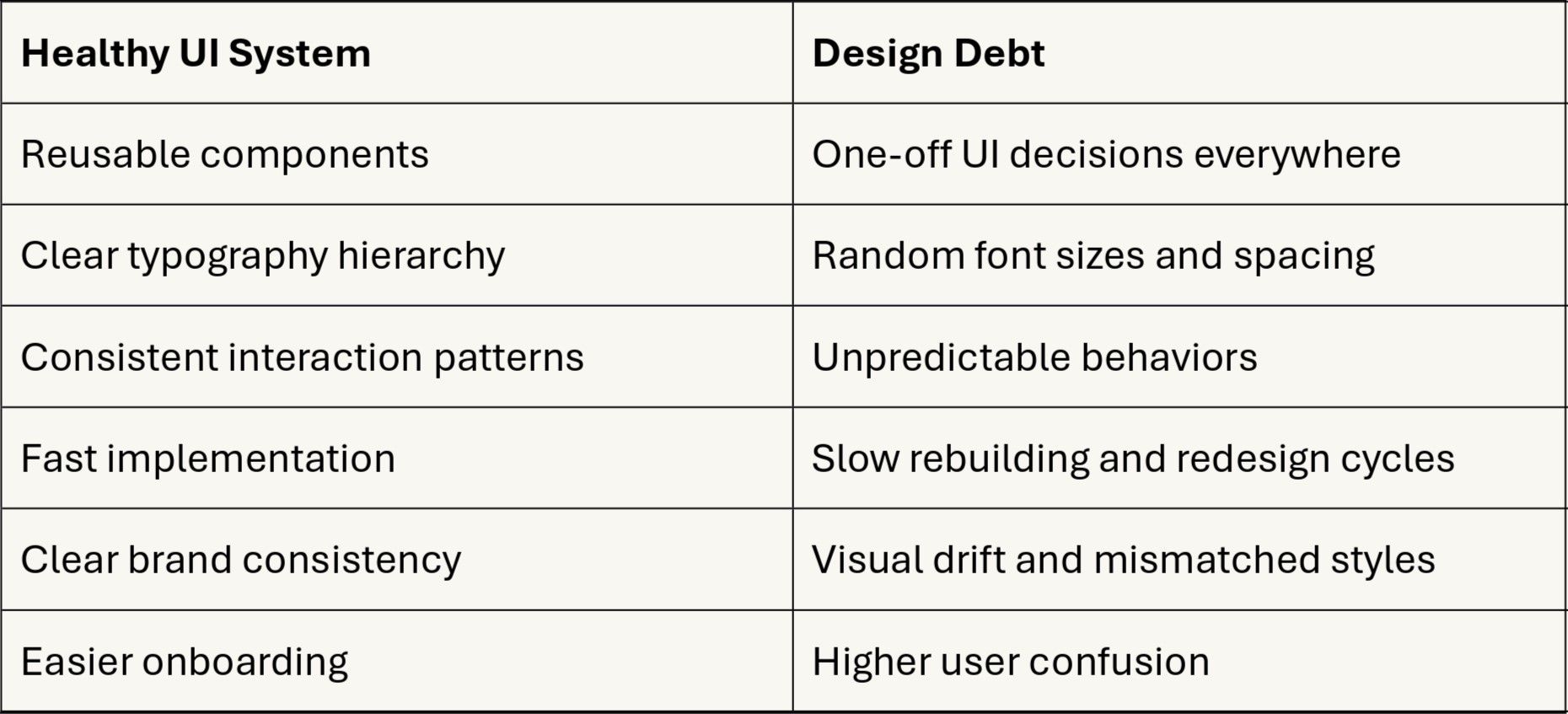
A system creates speed without chaos. Design debt creates chaos disguised as speed.
How Design Debt Shows Up in Conversion and Trust
Design debt often shows up as “conversion problems” long before teams label it as design debt.
Common symptoms include:
- high bounce rates
- low CTA click-through
- users struggling to complete forms
- lower trust and slower decision-making
- increased support tickets for simple actions
These outcomes happen because design debt increases friction.
Friction increases effort. Effort increases abandonment.
Your product can be good, but if it feels inconsistent, users treat it as risky.
How to Reduce Design Debt Without Killing Speed
Many teams fear one thing:
“If we focus on design systems, we’ll slow down.”
That only happens when teams treat systems like a large project instead of a gradual layer.
Here is the practical approach:
Build a “minimum viable system”
Start with the core building blocks:
- typography scale
- spacing rules
- button styles
- form elements
- cards
- section layouts
You don’t need a full enterprise design system to reduce debt. You need consistency in the top 20% of UI that appears everywhere.
Create rules before components
Components alone won’t fix design debt if the rules are unclear.
Rules include:
- when to use which button
- which spacing values are allowed
- how headings should behave
- what hover states look like
- how sections are structured
Rules create predictability.
Fix debt where it compounds
Not every page matters equally.
Focus on:
- homepage
- pricing
- onboarding flows
- core product screens
- checkout
- booking forms
These are the pages where trust and conversion are most sensitive.
Where to Start: A Practical Design Debt Audit
If you want to identify design debt fast, audit these areas:
Components
- How many button styles exist?
- How many input styles exist?
- How many card patterns exist?
Layout consistency
- Are sections aligned to a consistent grid?
- Do spacing values follow a pattern?
Typography
- Do heading sizes follow a hierarchy?
- Are line heights and text rhythm consistent?
Interaction behavior
- Do forms validate consistently?
- Do modals behave predictably?
- Are states consistent across pages?
Language
- Does microcopy feel like it belongs to one brand?
The goal of this audit is not perfection. It is clarity.
You need to see where debt lives before you can pay it down.
Final Thought
Design debt is real.
It is not a “nice to have” problem. It becomes a compounding cost that slows teams, weakens trust, and reduces conversion over time.
The good news is that design debt does not require a dramatic redesign to fix. It requires a system mindset and consistent decisions.
Small UI decisions create big business outcomes.
And teams that take design debt seriously create something rare:
a product that scales without losing quality.