(And Why Trust Is Built Before Users Ever Read Your Content)
Trust is not something users decide consciously.
They don’t read a page, weigh pros and cons, and then conclude that a website feels trustworthy. Instead, trust is formed quietly, almost instantly, through subtle signals that shape how an experience feels.
One of the most powerful—and most misunderstood—of these signals is motion design.
When used intentionally, motion reduces uncertainty, reinforces clarity, and makes digital experiences feel reliable. When used poorly, it does the opposite.
This article explores how motion design shapes user trust on modern websites, why it works at a psychological level, and how brands can use motion to build confidence instead of distraction.
Why Trust Matters in Digital Experiences
Trust determines whether users continue or leave.
Before users sign up, purchase, or even scroll, they subconsciously decide whether an experience feels safe and reliable. If doubt appears early, rational evaluation rarely follows.
On modern websites, trust is communicated less through words and more through behavior. How the interface responds, transitions, and reacts matters as much as what it says.
Motion plays a central role in this behavior.
What Motion Design Really Communicates
Motion design is not about making interfaces feel “alive” or visually impressive.
At its core, motion communicates:
- Cause and effect
- System awareness
- Responsiveness
- Intentionality
When something moves in response to an action, users understand that the system has acknowledged them. This acknowledgment reduces uncertainty and builds confidence.
Motion tells users: something is happening, and it’s happening on purpose.
How Users Interpret Motion (Without Realizing It)
Users do not analyze motion consciously.
They simply react to how it makes them feel.
Smooth, predictable motion feels calm and controlled. Abrupt, inconsistent motion feels chaotic or broken. No motion at all can feel cold or unresponsive.
These reactions happen automatically. Users don’t label them as “motion design issues.” They label them as trust or distrust in the product itself.
Motion as Feedback, Not Decoration
The most effective motion is functional.
It confirms actions, explains changes, and reassures users that the system is responding as expected. Examples include subtle button feedback, smooth page transitions, or gentle loading indicators.
Decorative motion, on the other hand, draws attention without adding clarity. When motion competes with content or feels excessive, it creates distraction instead of confidence.
Trust grows when motion answers questions users didn’t know they had.
Consistency and Predictability in Motion
Trust depends on predictability.
When motion behaves consistently across a website, users quickly learn what to expect. They understand how interactions work and feel more in control.
Inconsistent motion—different speeds, styles, or behaviors across pages—breaks this predictability. Even small inconsistencies can make an experience feel unreliable.
Consistency turns motion into a language users can learn.
When Motion Damages Trust
Motion can undermine trust when it introduces friction or uncertainty.
This often happens when:
- Animations are too slow or too aggressive
- Motion interrupts reading or decision-making
- Transitions feel unpredictable
- Effects are used without purpose
In these cases, users feel that the interface is prioritizing style over usability. This perception quietly erodes confidence.
Trust is fragile. Motion should support it, not test it.
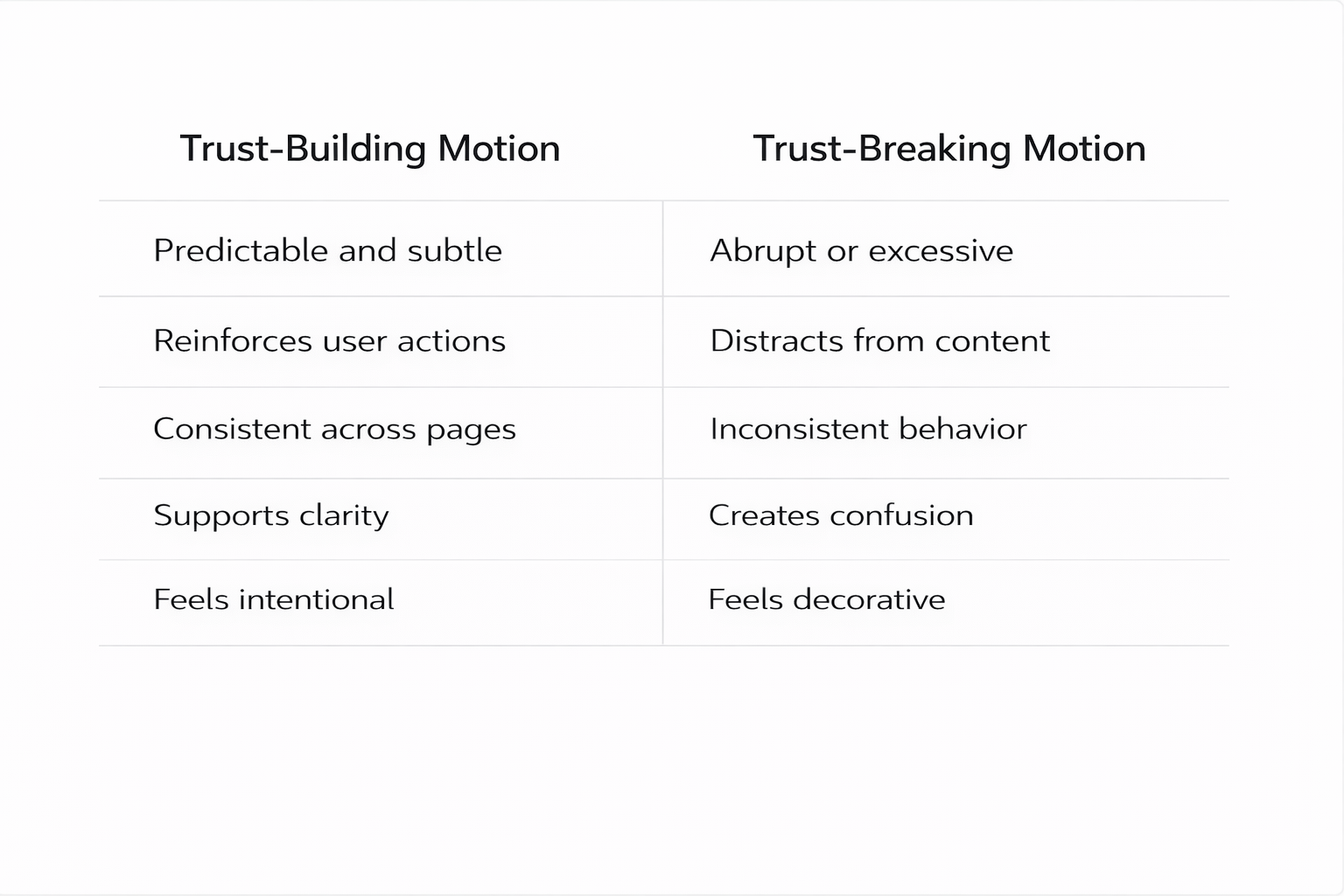
A Clear Comparison: Trust-Building vs Trust-Breaking Motion
This difference often determines whether motion strengthens or weakens the overall experience.
How to Use Motion to Strengthen User Confidence
Trust-building motion follows a few core principles:
- It responds immediately to user actions
- It explains changes in state
- It feels consistent across the experience
- It never competes with content
Motion should never ask for attention. It should quietly support understanding.
When users feel that the interface is working with them, trust grows naturally.
Where Motion Has the Biggest Impact
Motion has the strongest effect in moments of uncertainty:
- Form submissions
- Page transitions
- Loading states
- Navigation changes
These moments are where users are most likely to hesitate. Thoughtful motion reduces hesitation by signaling progress and control.
Final Thought
Users don’t trust websites because they look impressive.
They trust websites because they feel predictable, responsive, and intentional.
Motion design plays a critical role in shaping that feeling. When motion is clear and consistent, users feel oriented and confident. When it is careless or excessive, doubt appears.
Modern websites don’t need more animation.
They need better motion—motion that earns trust quietly, one interaction at a time.